Free core listening, no app-inserted ads
The core player is free for core listening with no app-inserted advertisements. No app-inserted banners, pre-rolls, or promoted feed placements. The player works without an account.
An independent podcast player built for listeners, not advertisers. Built and operated by Magnolia Apps (Ken Webster). This page covers who we are, how the app is funded, and how every page on this site is written and checked.


| Claim | Truth |
|---|---|
| Who | Magnolia Apps · Ken Webster — independent; no network, ad company, or streaming service behind it |
| Core player | Usable without Premium |
| Offline | Unlimited downloads free — Premium ≠ downloads |
| Ads | No app-inserted ads; host-read mid-rolls may remain |
We got tired of podcast apps that treat listeners as ad inventory. Most of the biggest players are owned by a media or streaming company, carry promotions, or hold basic features like offline downloads or a clean queue behind a subscription. We thought podcast listening should be free, private, and distraction-free — so we built it ourselves.
The core player is free for core listening with no app-inserted advertisements. No app-inserted banners, pre-rolls, or promoted feed placements. The player works without an account.
Ask questions across eligible transcript-backed listening history. Brain finds the answer, names the source, and links you back to the exact moment in the episode.
AI-generated podcast summaries that distill your subscriptions into short, listenable recaps so you never fall behind.
Download episodes for offline listening with smart storage management. Unlimited offline downloads are free. Premium is Podcast Brain — it does not unlock or expand offline.
Car integration on both platforms — CarPlay on iOS, Android Auto on Android. Browse, queue, and control playback from your vehicle's dashboard without touching your phone.
Watch video podcasts with picture-in-picture support. Switch between audio and video seamlessly without losing your place.
We do not sell your data or use it for advertising. No third-party ad tracking beyond basic analytics. Your listening history and Brain conversations stay private. See our privacy policy for details.
We are not owned by a media conglomerate, a music streaming company, or an advertising platform. Our incentives are aligned with listeners, not advertisers or content deals.
We use Podcast Index and standard RSS feeds — not a walled garden. Your subscriptions are yours. Import and export with OPML anytime.
The Podcast App started from a simple annoyance: opening a podcast app should not feel like fighting through a subscription upsell before you can press play. Most big podcast apps are owned by a media company, a music-streaming platform, or an ad network, and their incentives show up in the product - banners between episodes, playback features held back until you subscribe, or a queue that nudges you toward whatever content someone else paid to promote. We wanted a player where subscribing to a show, building a queue, and hitting play just worked, for free, without anyone's business model getting between you and the audio.
Free core listening has to be paid for somehow, and we chose the most direct route: an optional Brain subscription for AI-powered search and episode summaries, and nothing else. There is no app-inserted advertising inside episodes, no data-broker relationship selling your listening habits to marketers, and no artificial cap on downloads or speed controls designed to make the free tier annoying enough that you upgrade. If you never touch Brain, you are using the identical player as someone who pays for it. The business exists because some listeners find enough value in the AI layer to pay for it directly, not because your attention is the product being sold.
That funding choice shapes the values we try to hold ourselves to: privacy first, meaning your listening history and any Brain conversations are not sold or repurposed for ad targeting; honesty about limits, meaning if something does not work - a feed that will not load in the browser player, a show with no transcript for Brain to search - we say so instead of papering over it with a vague error message; and a listener-first bar for every feature we ship, where the real question is always whether it makes listening better, not whether it increases time-in-app or ad impressions.
We also believe podcasting should stay an open medium, not a collection of walled gardens. The app is built on standard public RSS feeds and the open Podcast Index rather than a proprietary catalog, so your subscriptions stay portable: import an OPML file from whatever app you used before, and export the same way if you ever want to leave. No show is exclusive to us, no feed is held hostage, and no listener is locked in. That commitment to the open podcast ecosystem is not a marketing line - it is the actual technical foundation the app is built on.
Who: The Podcast App is built and operated by Ken Webster under Magnolia Apps. We are an independent app maker — not a podcast network, an ad network, or a Big Tech music service. The same name is on the App Store and Google Play listings, the privacy policy, and the changelog.
How: Product claims on this site come from shipping and using the iOS and Android apps — OPML import without an account, unlimited offline downloads on free, Smart Ad-Skip on supported podcasts, Podcast Brain as the optional Premium. Comparison tables list constraints we can verify in-app, not scraped feature matrices. The rules are written out in the editorial policy below.
Why: These pages exist so a listener deciding whether to switch apps can see free vs Premium clearly (Premium is Podcast Brain, not a download unlock) and move a library in or out with OPML. They are not a keyword farm or a show-ranking mill, and nothing on this site is paid placement.
Something wrong or missing? Contact support — corrections land on the page itself, not in a footnote.
This is the standard every page on thepodcastapp.dev is held to, including this one. It is a product site written by the people who build the product. It is not a content operation.
A page exists here because a listener has a real question about the app: is the core player actually free, does Premium unlock downloads, can I leave with my OPML, what does Ad-Skip really do. If there is no such question behind a page, we retire the page. We do not write pages to catch a keyword.
Claims are read from the shipped iOS and Android app, its source code, and its release tooling — the same build you install from the App Store or Google Play. Screenshots are real captures of the shipped app from our store-listing set, not mockups. A claim we cannot check that way is either marked as unverified on the page or left out.
Competitor rows come from the vendor's own public documentation and from using their apps. We list constraints we can verify; where we cannot, the row says so. Nobody is ranked by fame, follower count, or payment: no show, network, or app vendor pays to appear on this site, and there is no advertising on it.
Smart Ad-Skip works on supported podcasts — episodes where an ad-segment map exists — and only when you tap it. It never edits audio, and host-read ads baked into the recording may remain. Every page here says "supported podcasts" and nothing broader. If you find a wider Ad-Skip claim anywhere on this site, that is a defect; report it and we will fix it.
"Last updated" on a page, and the modified date in its structured data, move only when the page's content genuinely changed. We do not re-stamp pages to look fresh, and we do not republish old pages under new dates.
A wrong claim, a dead link, a stale price, a feature we describe that you cannot find in the app: tell us through the support page. We fix it on the page itself and move the date. We do not quietly delete the mistake or bury it.
Drafts are produced with software, including AI writing assistants. Drafting is not publishing. Before a page can deploy it must pass automated checks — it has to be substantially different from every sibling page, carry a minimum of original content, and stay inside the small set of pages we index on purpose — and the operator named above is accountable for every claim that goes live.
In 2026 we retired the large majority of the pages this site once had — templated "best app for X" lists and genre pages that answered no real question — and consolidated them into roughly 45 pages we stand behind. A site that publishes its own datasets and methodology should be willing to shrink. Fewer pages we can defend beat more pages that rank.
These are real captures of the shipped app from our store-listing set, not mockups — the player, home, downloads, and Podcast Brain screens as they look after install. The app is also fully localized; the Spanish, German, Japanese and other language pages show the same screens in those languages.
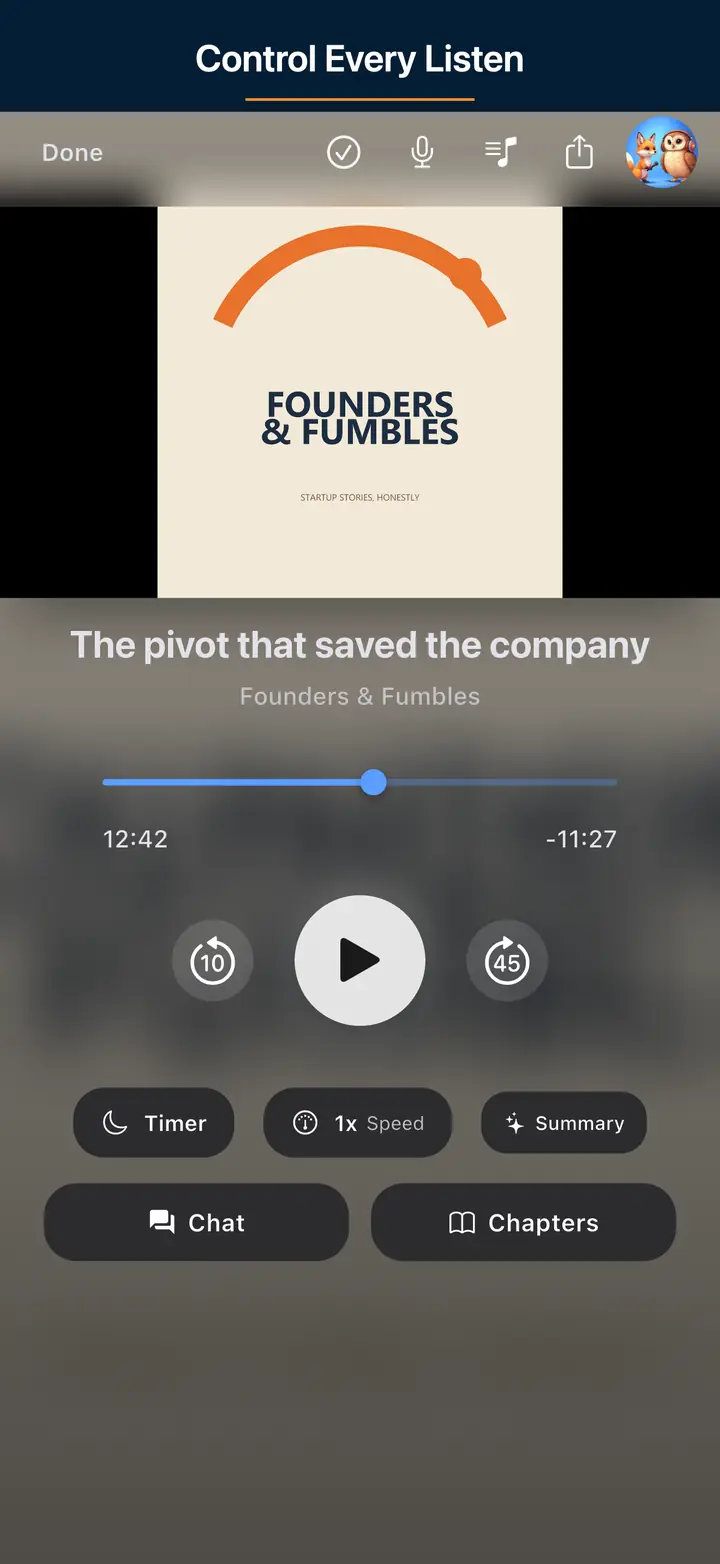
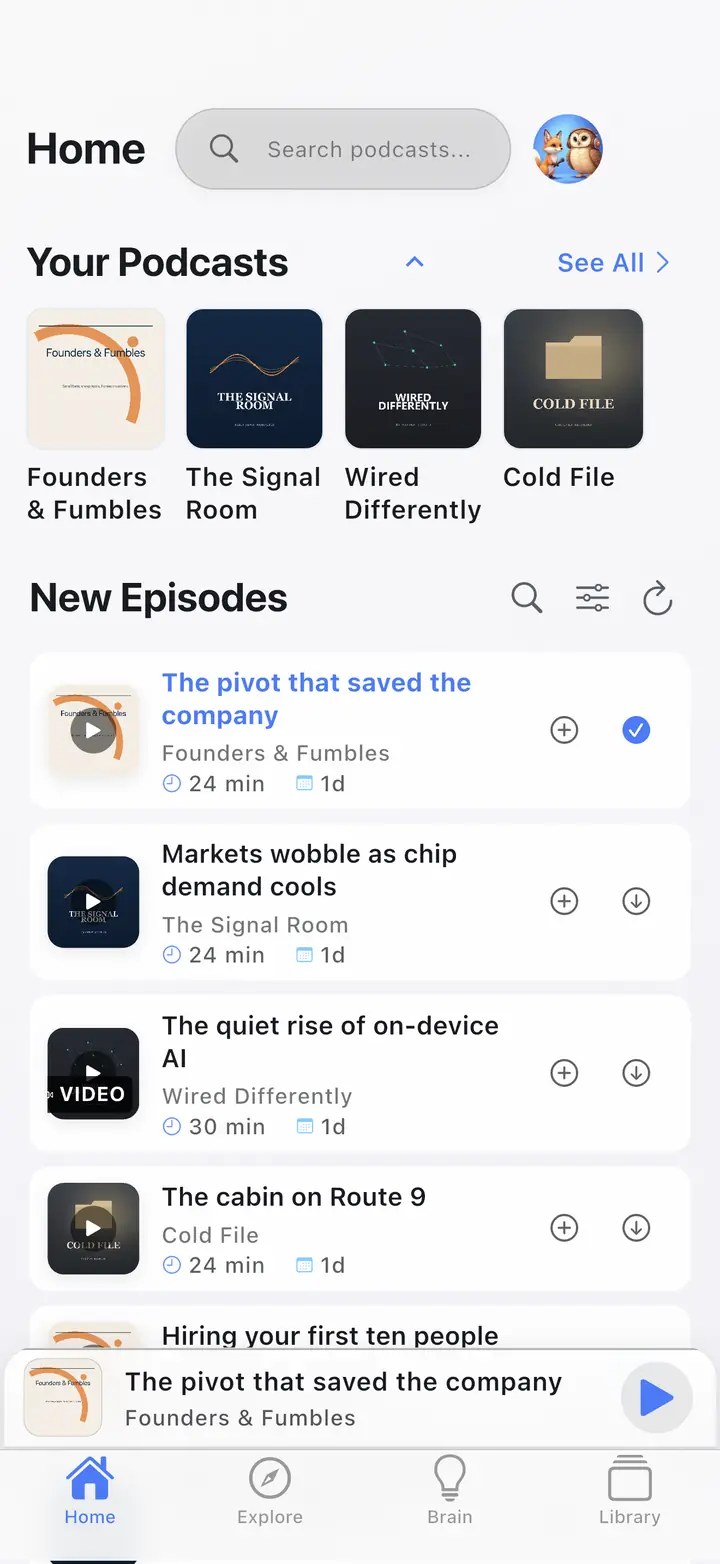
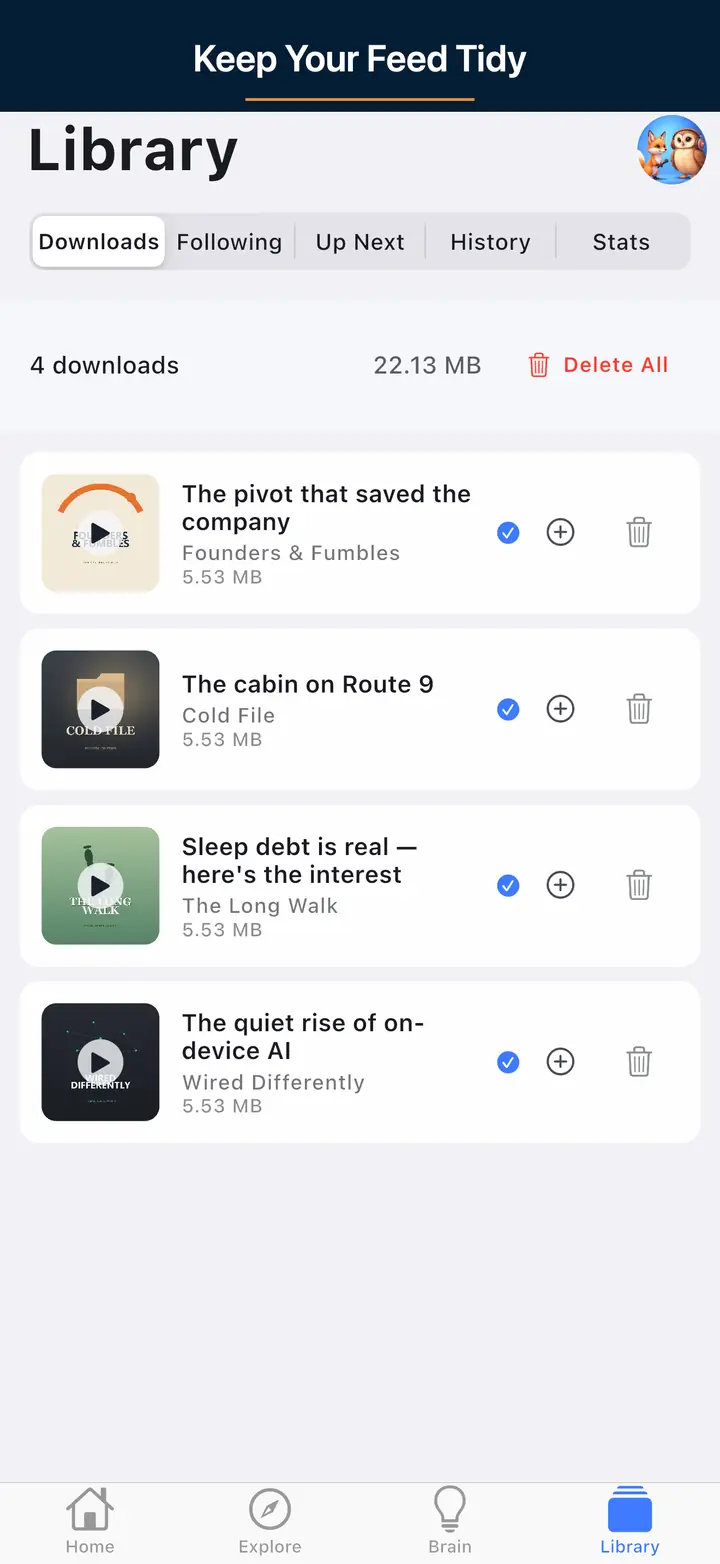
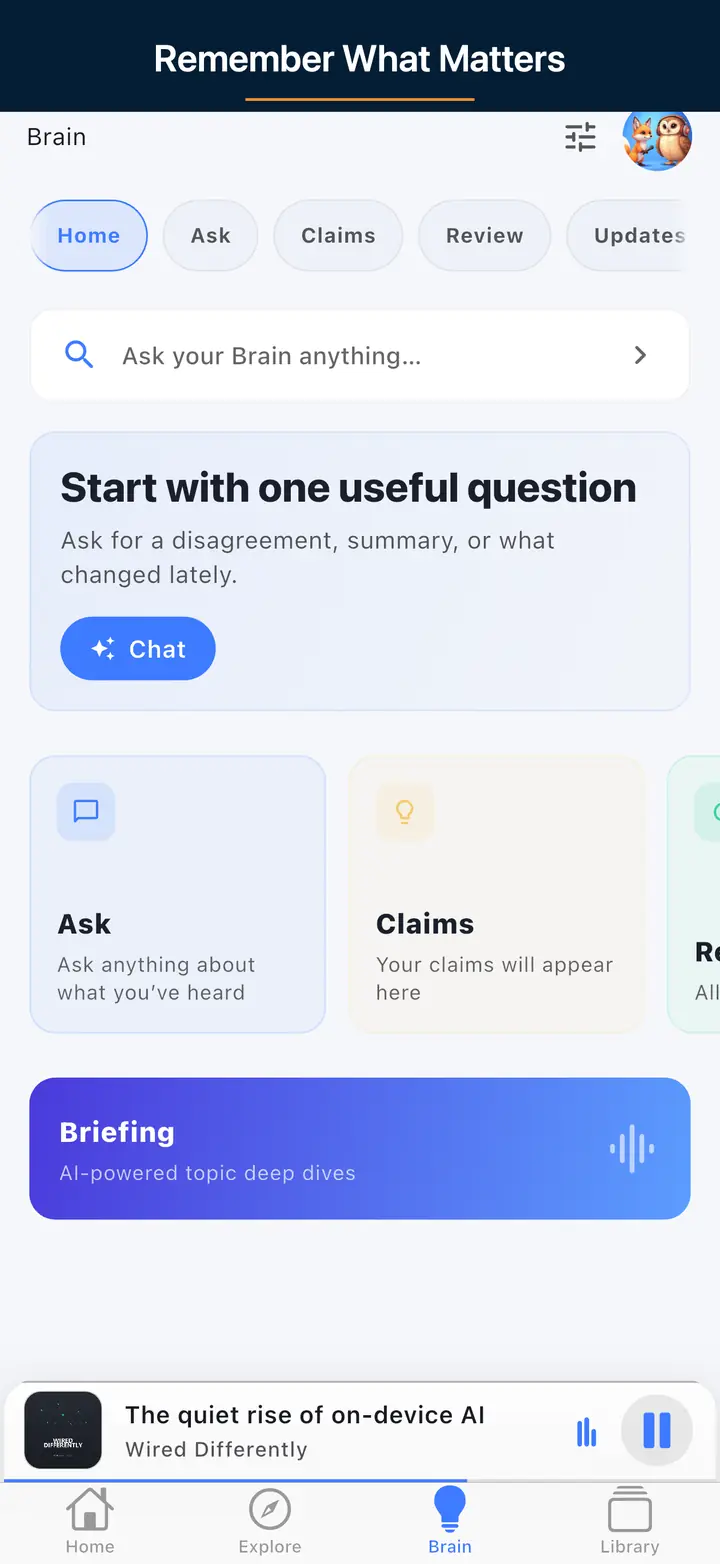
The Podcast App is an independent podcast player for iPhone and Android. It handles the core listening experience — subscribing to shows, building a queue, variable-speed playback, offline downloads, CarPlay on iOS — with optional AI features like Podcast Brain search on top. It works without an account, and the core player is free to use.
The app does not insert its own banners, pre-rolls, or promoted feed placements into your listening. You will not see app-inserted advertisements in the player. Note that some episodes contain ads baked into the audio by the podcast's own publisher — no third-party app can strip those, since they are part of the recording itself.
It is built by an independent team (Magnolia Apps), not by a music-streaming service, media conglomerate, or advertising platform. That independence is deliberate: because the product is not funded by ad inventory or exclusive content deals, the design goal is a player that answers to listeners rather than advertisers.
No. The app does not sell your data or use it for third-party ad targeting, and your listening history and Podcast Brain conversations are treated as private. It uses basic analytics to keep the app working, not ad-tracking profiles. Full details are in the privacy policy linked from the About page.
Yes. The app is built on open standards — standard RSS feeds and the Podcast Index — rather than a closed catalog. You can import your existing shows with an OPML file and export your subscriptions the same way, so your library stays portable and is not locked to one app.
Every page is written by the people who build the app, to answer a question a listener actually has about it — free versus Premium, offline, OPML, ads. Product claims are read from the shipped iOS and Android app and its source code, not from a scraped feature matrix. Drafts are produced with software, including AI writing assistants, and a page cannot deploy until it clears automated uniqueness and length checks. No show, network, or app vendor pays for placement, and there is no advertising on this site. The full policy is in the editorial section of this page.
No, and we do not claim it does. Smart Ad-Skip works on supported podcasts — episodes where an ad-segment map exists — and it is a one-tap skip you trigger, not automatic removal. The app never strips audio, and host-read ads baked into the recording may remain. Every page on this site that describes Ad-Skip says supported podcasts and nothing broader.
We read every message. If something is broken, confusing, or missing — we want to hear about it.